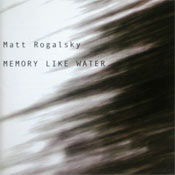
MEMORY LIKE WATER
Disc 1
- Resonate (noise) 13:06
- Resonate (tones) 26:04
- Kash (violin) 22:48
- Kash (guitars) 14:08
- Sprawl (western magnetics) 22:44
- Kash (radios) 24:38
- Transform 31:19
The six (or seven) pieces on these CDs document live performance works which span 1996 to the present. Most of the solo pieces are structured improvisations, in that they have a broad form which is repeated from performance to performance while the detail is always quite different. The collaborative pieces are less formalized and depend hugely upon the input of my co-performers. I am very grateful to have worked with them.
Conceived as two halves of a single piece, Resonate (noise) and Resonate (tones) seamlessly crossfade from one to the other. Both are sustained-sound pieces, the first exploring noise textures, the second exploring dense, quasi-orchestral harmonic territory. Both pieces employ original software which generates sound using a type of granular synthesis, triggering sampled sources many hundreds of times per second.
The three works entitled Kash are all related in that they employ the same original software instrument (of that name) initially developed in 2001 and still in use today. This software enables me to interact with live performers (or other sound sources) in fluid and lively improvisational situations, accumulating and processing fragments of low-level sounds (the "spaces between the notes"). The three performances with my Kash instrument represented here show how very different the outcomes can be, depending on who (or what) my co-performers are. In each case, all the electronic sound is derived from their real-time input.
Kash (vln) is a collaborative improvisation between myself and violinist Jane Henry, recorded live. Jane is a composer-performer whose performance techniques involve, among other things, use of multiple violin bows made of different abrasive materials. Kash (gtrs) is a live studio recording featuring my brothers Benjamin and Luke Rogalsky on steel-string acoustic guitars. This performance was an improvisation based on a few suggestions as to overall structure. Kash (radios) is a live recording made before an audience at Experimental Intermedia in New York City on March 8 2001. In this case, the "performers" with whom I am interacting are two radios, tuned to talk stations. The radios are faintly heard at the beginning of the piece, but soon the direct sound disappears and only the processed sound remains.
Sprawl (western magnetics) is a document of a live solo performance. As with Kash, Sprawl is a software instrument still in current use, which I developed to be employed in many different improvisational situations. Input from a live performer, or any other sound source, can be sampled and explored at the micro-level using a granular synthesis technique controlled by an computer graphics tablet. Many textural layers of sound can be built up to a dense wall of sound but equally delicate melodic lines can be drawn out as well. On this occasion the input sounds were provided by my brother Luke Rogalsky.
Transform is a manipulation of a live radio signal, tuned to any music station;
the frequency content of the source radio program is brought out by a series
of tunable delays which create strong harmonic resonances. These harmonies are
constantly shifting throughout the piece, which is performed in two sections,
the first relatively quiet and the second fairly loud, where the processing
used causes the radio to take on the character of an electric guitar constantly
on the verge of feedback. Overlaid on the resonant radio in the middle and end
sections are sounds of a quite different character generated with electronic
feedback loops. The underlying radio signal may sometimes be heard emerging
from the dense processed sound.
- Matt Rogalsky